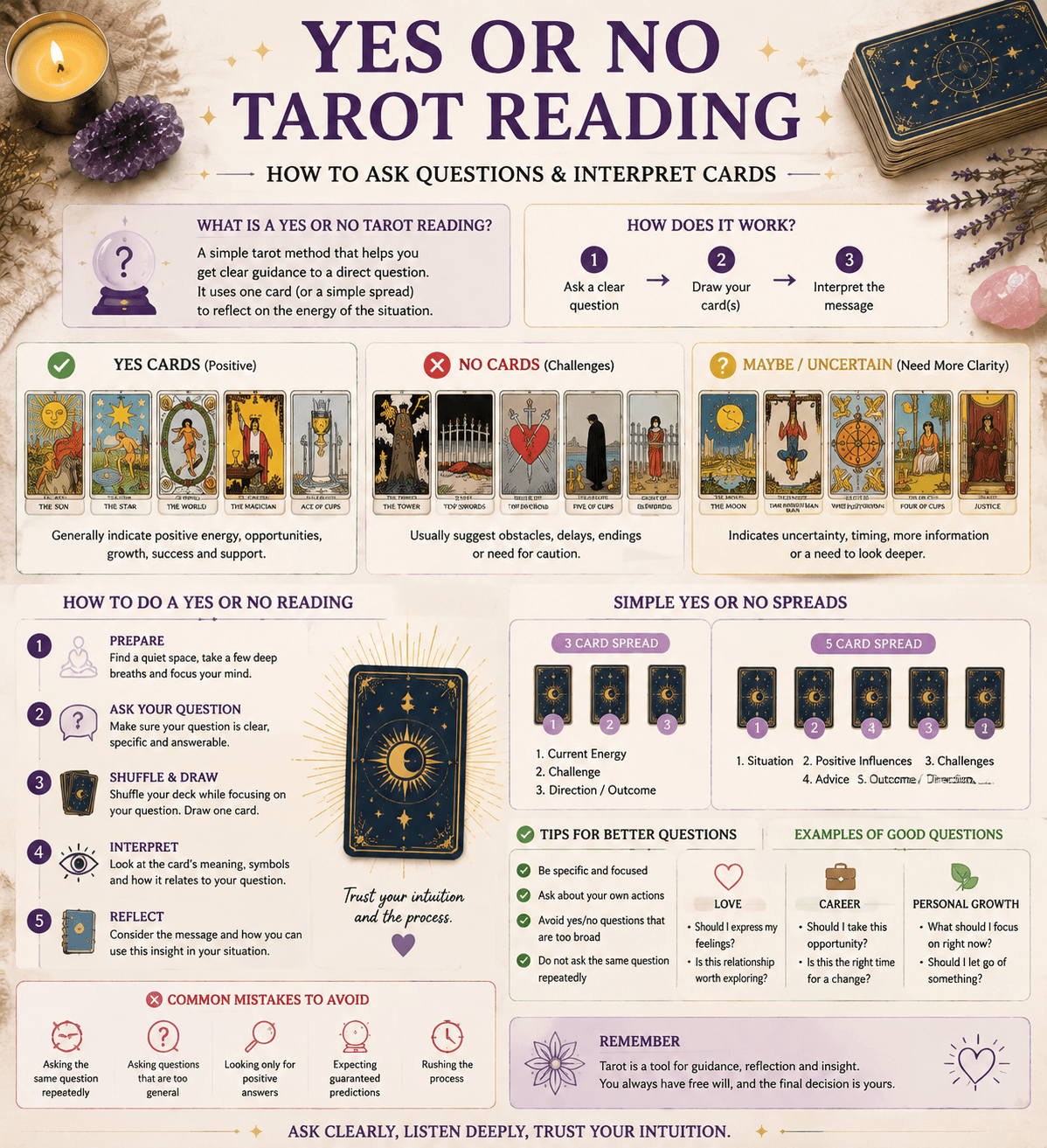
Yes or No Tarot Reading: How to Ask Questions and Interpret Cards
Introduction
Many beginners start learning tarot because they want quick answers to simple questions.
A yes or no tarot reading is one of the easiest ways to begin practicing because it focuses on a clear question and a simple interpretation.
Unlike larger tarot spreads that explore many details, a yes or no reading usually involves:
- One card
- One focused question
- One moment of reflection
Beginners often wonder:
- How do yes or no tarot readings work?
- Which cards mean yes or no?
- What questions should I ask?
- Can one tarot card really provide guidance?
This guide explains how beginners can use yes or no tarot readings, create better questions, and understand card meanings.
What Is a Yes or No Tarot Reading?
A yes or no tarot reading is a simple tarot method designed around a direct question.
Instead of exploring a complex situation, the reader asks a question that can be viewed through a positive, negative, or uncertain perspective.
Examples:
Question:
“Should I accept this new opportunity?”
Question:
“Is this relationship worth exploring?”
Question:
“Should I start a new project?”
The goal is not simply getting an answer, but reflecting on the situation from a different perspective.
How Does Yes or No Tarot Work?
A basic yes or no tarot reading usually follows three steps.
Step 1: Create a Clear Question
The quality of your question affects the quality of your reflection.
Good questions are:
✅ Specific
✅ Focused
✅ Open to understanding
Example:
Better:
“Should I focus more energy on my career right now?”
Instead of:
“Will my whole life be successful?”
Step 2: Draw a Tarot Card
Many beginners use a one-card method.
The process:
- Shuffle the deck
- Focus on the question
- Draw one card
- Reflect on its meaning
Step 3: Interpret the Card
The card can be viewed through:
- Traditional meanings
- Symbols
- Personal intuition
- The context of the question
Yes or No Tarot Reading – Part 2
Yes Tarot Cards: Cards Often Associated With Positive Answers
In yes or no tarot readings, some cards are traditionally viewed as carrying more positive or encouraging energy.
These cards may represent:
- Progress
- Opportunities
- Harmony
- Growth
- Success
However, tarot interpretation depends on the question, context, and reader’s approach.
The Sun ☀️
Meaning: Strong Yes
Keywords:
- Happiness
- Success
- Clarity
- Positive outcomes
The Sun is often considered one of the most positive cards in tarot.
For a yes or no question, it may suggest:
- Moving forward
- Confidence
- A favorable direction
The Star ⭐
Meaning: Yes
Keywords:
- Hope
- Healing
- Inspiration
- Possibilities
The Star represents optimism and renewal.
It may suggest that a situation has positive potential.
The World 🌎
Meaning: Yes
Keywords:
- Completion
- Achievement
- Success
The World can indicate reaching a goal or completing an important cycle.
The Magician
Meaning: Yes
Keywords:
- Action
- Skills
- Manifestation
The Magician suggests that you have the tools needed to move forward.
The Empress
Meaning: Yes
Keywords:
- Growth
- Abundance
- Creativity
The Empress represents nurturing energy and positive development.
The Lovers
Meaning: Yes
Keywords:
- Connection
- Harmony
- Choices
In relationship questions, The Lovers is often viewed as a positive card.
Ace of Cups
Meaning: Yes
Keywords:
- New emotions
- Love
- Emotional beginnings
Often connected with new relationships or emotional opportunities.
Ace of Pentacles
Meaning: Yes
Keywords:
- New opportunities
- Stability
- Prosperity
This card may suggest a practical opportunity.
Six of Wands
Meaning: Yes
Keywords:
- Victory
- Recognition
- Success
The Six of Wands represents achievement and confidence.
No Tarot Cards: Cards Often Associated With Challenges
Some cards traditionally suggest caution, delays, or obstacles.
They may indicate:
- Waiting
- Reconsidering
- Problems to solve
The Tower
Meaning: Usually No / Not Now
Keywords:
- Unexpected change
- Disruption
- Sudden realization
The Tower may suggest that the current path needs adjustment.
Ten of Swords
Meaning: No
Keywords:
- Ending
- Completion
- Difficult transition
This card often represents something coming to an end.
Five of Cups
Meaning: Not Favorable
Keywords:
- Disappointment
- Loss
- Emotional difficulty
It may suggest looking at what is missing rather than available.
Eight of Swords
Meaning: Not Yet
Keywords:
- Fear
- Restrictions
- Feeling stuck
This card may suggest that something is blocking progress.
Four of Cups
Meaning: Maybe / Reconsider
Keywords:
- Reflection
- Missed opportunities
- Lack of motivation
It encourages looking deeper before making a decision.
Three of Swords
Meaning: Usually No
Keywords:
- Heartbreak
- Conflict
- Emotional pain
Often associated with difficult emotional situations.
Five of Pentacles
Meaning: Challenging
Keywords:
- Difficulty
- Lack of support
- Concerns
May indicate obstacles that need attention.
Tarot Cards That Mean “Maybe” or Need More Context
Not every card gives a simple yes or no answer.
Some cards suggest:
- More information is needed
- Timing matters
- The situation is changing
The Moon
Meaning: Unclear
Keywords:
- Mystery
- Hidden information
- Intuition
The Moon suggests that everything may not be visible yet.
The Hanged Man
Meaning: Wait
Keywords:
- Patience
- New perspective
- Pause
This card suggests avoiding rushed decisions.
Wheel of Fortune
Meaning: Depends on Timing
Keywords:
- Change
- Cycles
- Movement
The situation may change unexpectedly.
Justice
Meaning: Depends on Choices
Keywords:
- Balance
- Truth
- Decisions
This card suggests considering facts carefully.
How to Ask Better Yes or No Tarot Questions
The question itself is one of the most important parts of a reading.
A clear question creates a clearer reflection.
Avoid Very Broad Questions
Bad example:
❌ “Will I be happy?”
This is too general.
Better:
✅ “What should I understand about my current path toward happiness?”
Avoid Questions About Controlling Others
Instead of:
❌ “Will this person fall in love with me?”
Try:
✅ “What can I understand about this relationship?”
Focus on Your Own Actions
Helpful questions:
- Should I explore this opportunity?
- What should I consider before making this decision?
- Is this the right time to take action?
Best Yes or No Tarot Questions for Beginners
Love Questions
- Should I continue exploring this relationship?
- Is this connection worth understanding further?
- Should I communicate my feelings?
Career Questions
- Should I apply for this opportunity?
- Is this a good time to learn a new skill?
- Should I explore a different career direction?
Personal Growth Questions
- Should I focus more on this goal?
- Is there something I need to change?
- Should I take action on this idea?
How to Do a Yes or No Tarot Reading at Home
One of the reasons yes or no tarot readings are popular among beginners is that they are simple to practice.
You do not need complicated layouts or advanced knowledge.
A basic reading can be done with:
- A tarot deck
- A quiet space
- A clear question
- A few minutes of reflection
Step 1: Prepare Your Space
Before starting, create a comfortable environment.
Some beginners like to:
- Sit somewhere quiet
- Light a candle
- Keep a tarot journal nearby
- Remove distractions
The goal is to create a focused moment.
Step 2: Choose Your Question
Take time to think about what you want to explore.
A good yes or no question should be:
- Clear
- Specific
- Related to your own choices
Examples:
“Should I start this new project?”
“Should I have an honest conversation?”
“Is this opportunity worth exploring?”
Step 3: Shuffle the Tarot Cards
Shuffle your deck while focusing on your question.
Different people use different methods.
Some prefer:
- Traditional shuffling
- Cutting the deck
- Choosing a card intuitively
There is no single required method.
Step 4: Draw One Card
The simplest yes or no reading uses one card.
Place the card in front of you and consider:
- The traditional meaning
- The symbols on the card
- How it connects to your question
Step 5: Reflect on the Message
Instead of only asking:
“Is this yes or no?”
Consider:
- What is this card showing me?
- What should I understand?
- What action might be helpful?
This approach often creates a deeper experience.
Popular Yes or No Tarot Spreads
Although one card is the simplest method, beginners can also try slightly larger spreads.
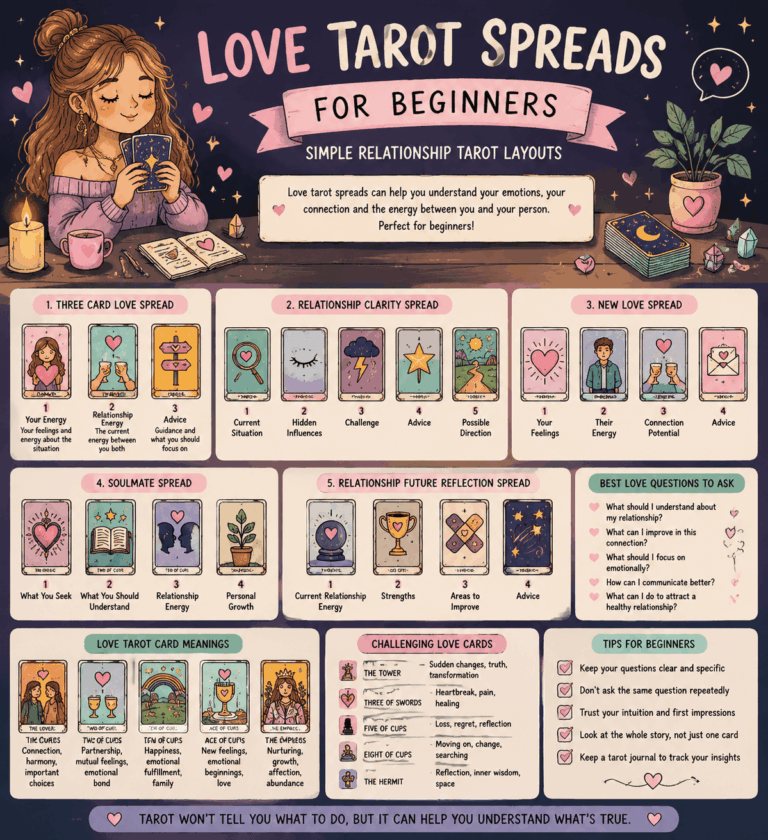
Three Card Yes or No Spread
This spread provides more context.
Card 1: Current Energy
What is influencing the situation?
Card 2: Challenge
What should you consider?
Card 3: Direction
What possible path should you explore?
Five Card Yes or No Spread
For more detailed questions:
Card 1:
Current situation
Card 2:
Positive influences
Card 3:
Challenges
Card 4:
Advice
Card 5:
Possible direction
Yes or No Tarot Reading for Love
Love is one of the most common topics for tarot questions.
Beginners often ask about:
- Relationships
- New connections
- Communication
- Emotional situations
Example Love Questions
Instead of:
❌ “Will this person love me forever?”
Try:
✅ “What should I understand about this connection?”
Instead of:
❌ “Will we definitely be together?”
Try:
✅ “What can I learn about this relationship?”
Example Love Tarot Spread
Card 1:
Your feelings
Card 2:
Relationship energy
Card 3:
Advice
This helps explore the situation instead of focusing only on a prediction.
Yes or No Tarot Reading for Career
Career questions are another popular topic.
People often ask about:
- New jobs
- Business ideas
- Career changes
- Learning opportunities
Example Career Questions
Good questions:
- Should I explore this opportunity?
- What should I consider before changing careers?
- Is this a good time to develop a new skill?
Common Mistakes Beginners Make
Learning yes or no tarot can be enjoyable, but beginners often make mistakes.
Asking the Same Question Repeatedly
A common mistake is drawing cards again and again for the same question.
This can create confusion.
A better approach:
- Ask once
- Reflect on the answer
- Give yourself time
Asking Questions That Are Too General
Very broad questions are difficult to interpret.
Example:
❌ “Will my life be good?”
Better:
✅ “What area of my life should I focus on right now?”
Looking Only for Positive Answers
Tarot cards are not only about positive outcomes.
A challenging card can still offer useful reflection.
For example:
The Tower may suggest change.
The Hermit may suggest taking time to reflect.
Treating Tarot as a Guaranteed Prediction
Many people use tarot as a tool for:
- Reflection
- Personal insight
- Exploring possibilities
It is best approached with an open mind and personal judgment.
Tips for Better Yes or No Tarot Readings
Keep Questions Simple
Simple questions are easier to explore.
Keep a Tarot Journal
Write down:
- Your question
- Card drawn
- First thoughts
- Later reflections
This helps you notice patterns over time.
Learn Card Combinations
As you gain experience, you can explore how multiple cards interact.
Practice Regularly
Even a few minutes of practice can improve your understanding.
Final Thoughts
A yes or no tarot reading is one of the easiest ways for beginners to start learning tarot.
With a simple question and one card, beginners can practice:
- Understanding symbols
- Learning card meanings
- Developing interpretation skills
The most important part of tarot is not only finding a quick answer, but reflecting on the message and considering different perspectives.
Whether you use tarot for curiosity, personal reflection, or spiritual exploration, starting with simple readings can help you build confidence.
Take your time, learn the meanings, and allow your understanding to grow naturally.
Frequently Asked Questions
What is a yes or no tarot reading?
A yes or no tarot reading is a simple tarot method where a card is interpreted to explore a direct question.
How many cards should I use for a yes or no tarot reading?
Beginners often start with one card. More detailed readings can use three or five cards.
Which tarot cards mean yes?
Cards such as The Sun, The Star, The World, and The Magician are often viewed as positive cards.
Which tarot cards mean no?
Cards such as The Tower, Ten of Swords, and Three of Swords may suggest challenges or delays.
Can beginners do yes or no tarot readings?
Yes. Beginners can start with simple one-card readings and gradually learn more.
What questions should I ask tarot cards?
Good questions focus on your choices, actions, and understanding of a situation.
Can tarot give guaranteed answers?
Tarot is generally used as a reflection tool rather than a guaranteed prediction method.
How often can I do a tarot reading?
Many beginners practice daily or weekly, depending on personal preference.
What is the easiest tarot spread?
The one-card tarot spread is usually the easiest for beginners.