Tarot Journal Ideas: How to Start a Tarot Journal for Beginners
Introduction
Learning tarot is a journey that becomes easier with practice and reflection.
Many beginners study card meanings, try different spreads, and watch tarot tutorials, but they often miss one of the most powerful learning tools:
A tarot journal.
A tarot journal helps you record your readings, understand card patterns, and develop your personal connection with tarot.
Beginners often ask:
- What should I write in a tarot journal?
- How do I start a tarot journal?
- What tarot journal prompts should I use?
- How can journaling improve my readings?
In this guide, we will explore simple tarot journal ideas, helpful prompts, and ways to build a consistent tarot practice.
What Is a Tarot Journal?
A tarot journal is a notebook or digital record where you document your tarot practice.
It can include:
- Daily card pulls
- Tarot readings
- Card meanings
- Personal interpretations
- Questions and reflections
Unlike simply memorizing meanings, journaling helps you understand how cards connect with real-life experiences.
Why Should Beginners Keep a Tarot Journal?
A tarot journal can help you:
Learn Card Meanings Faster
Writing about cards repeatedly makes their meanings easier to remember.
Track Your Progress
Over time, you can see how your interpretation skills improve.
Understand Personal Symbolism
Different people connect with tarot imagery in different ways.
A journal helps you discover your own relationship with the cards.
Improve Your Readings
Reviewing previous entries can reveal patterns and insights.
What to Write in a Tarot Journal
Many beginners buy a notebook but do not know how to use it.
A tarot journal does not need to be complicated.
The goal is to create a place where you can record your learning process and personal observations.
Here are some useful sections to include.
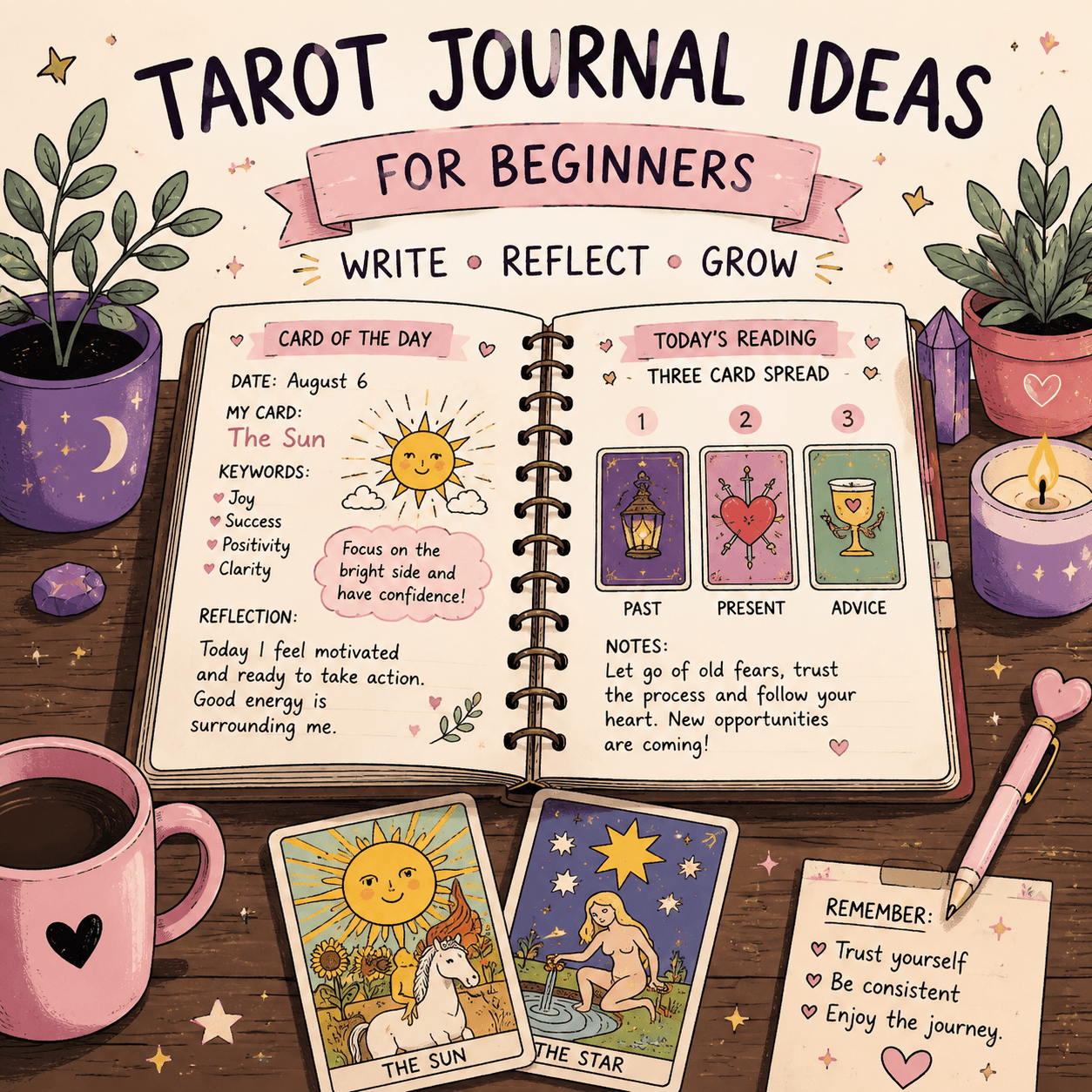
1. Daily Tarot Card Pulls
A daily card pull is one of the easiest ways to practice.
Each morning, choose one card and write:
- Date
- Card name
- First impression
- Traditional meaning
- How the card may relate to your day
Example:
Date: August 6
Card: The Star
Keywords:
Hope, healing, inspiration
My reflection:
“I want to focus on staying positive and trusting my progress.”
2. Tarot Card Meaning Pages
Create a separate page for each tarot card.
Include:
Card Name
Example:
The Lovers
Keywords
- Love
- Connection
- Choices
Traditional Meaning
Write the common interpretation.
Personal Meaning
Ask yourself:
- What does this card represent to me?
- What symbols stand out?
- What emotions does it create?
3. Tarot Reading Records
Whenever you complete a reading, record the details.
A simple format:
Question:
What do I need to understand about my current situation?
Spread:
Three Card Spread
Cards:
- The Hermit
- The Star
- The Sun
Interpretation:
Write your thoughts about how the cards connect.
4. Tarot Spread Ideas
Keep a list of spreads you enjoy.
Examples:
One Card Spread
Question:
“What should I focus on today?”
Three Card Spread
- Past
- Present
- Future
Relationship Spread
- My feelings
- Their energy
- Advice
Career Spread
- Current situation
- Opportunities
- Next step
5. Tarot Dreams and Intuition Notes
Some tarot readers like recording:
- Dreams
- Intuitive feelings
- Symbols they notice
- Repeating themes
This can help you understand your personal connection with tarot.
Tarot Journal Prompts for Beginners
Prompts can make journaling easier.
Here are some questions you can use.
Card Understanding Prompts
- What is the first thing I notice about this card?
- What emotions does this card create?
- What symbols appear important?
- What lesson might this card represent?
- How does this card connect with my current life?
Self-Reflection Prompts
- What area of my life needs attention?
- What pattern am I noticing?
- What can I learn from this situation?
- What perspective can help me move forward?
Relationship Tarot Journal Prompts
- What can I understand about my relationship patterns?
- How can I communicate better?
- What qualities do I value in relationships?
- What emotional lessons am I learning?
Career Tarot Journal Prompts
- What skills should I develop?
- What opportunities should I explore?
- What motivates me?
- What challenges can help me grow?
Creating a Tarot Journal Routine
A consistent routine can improve your tarot practice.
You do not need to write for hours.
Even 5–10 minutes daily can help.
Morning Tarot Journal Routine
Step 1:
Draw one card.
Step 2:
Write the card meaning.
Step 3:
Write how you feel about the card.
Step 4:
Reflect at the end of the day.
Weekly Tarot Review
Once a week, review your entries.
Look for:
- Repeated cards
- Common themes
- Personal insights
- Changes over time
This helps you understand your tarot journey.
Digital vs Physical Tarot Journals
Both options can work.
Physical Tarot Journal
Advantages:
✅ Creative
✅ Personal
✅ Easy to decorate
✅ More connected feeling
Many beginners enjoy adding:
- Drawings
- Stickers
- Colors
- Card images
Digital Tarot Journal
Advantages:
✅ Easy organization
✅ Searchable notes
✅ Available anywhere
You can use:
- Notes apps
- Digital notebooks
- Document tools
50 Creative Tarot Journal Ideas for Beginners
A tarot journal can be completely personalized.
There is no single correct way to create one.
Some people prefer simple notes, while others enjoy creating artistic pages with drawings, colors, and decorations.
Here are creative ideas you can add to your tarot journal.
Daily Practice Ideas
1. Card of the Day
Write:
- Card drawn
- Main meaning
- How it connects to your day
2. Morning Intention Page
Before pulling a card, write:
- How do I feel today?
- What energy do I want to focus on?
- What do I want to understand?
3. Evening Reflection
At the end of the day, review:
- Did the card relate to my experiences?
- What did I learn?
- What surprised me?
4. Weekly Tarot Summary
Create a weekly page including:
- Cards pulled
- Common themes
- Lessons learned
5. Monthly Tarot Review
At the end of each month, write:
- Most common cards
- Biggest lessons
- Personal growth moments
Tarot Card Study Ideas
6. Create a Page for Each Card
Include:
- Card image
- Keywords
- Traditional meaning
- Personal interpretation
7. Compare Similar Cards
Example:
Compare:
- The Sun vs The Star
- Two of Cups vs The Lovers
- Eight of Cups vs The Hermit
8. Write Your First Impression
Before reading any guidebook:
Ask:
“What do I see in this card?”
9. Track Repeating Cards
Create a list of cards that appear often.
Reflect:
“Why might this card keep appearing?”
10. Create a Tarot Dictionary
Make a personal glossary of:
- Symbols
- Colors
- Numbers
- Elements
Tarot Reading Journal Ideas
11. Record Every Reading
Include:
- Date
- Question
- Spread
- Cards
- Interpretation
12. Create Spread Templates
Draw layouts for your favorite spreads.
Examples:
- Three-card spread
- Love spread
- Career spread
13. Track Your Accuracy
After some time, review old readings.
Ask:
- What did I understand correctly?
- What did I learn?
14. Record Emotional Reactions
Write:
- What feelings appeared?
- What card created the strongest reaction?
15. Keep a Question List
Create pages of questions you want to explore.
Creative Tarot Journal Ideas
16. Add Tarot Artwork
Draw:
- Cards
- Symbols
- Personal designs
17. Create Color Associations
Record colors that connect with different cards.
Example:
Blue:
- Calm
- Intuition
- Reflection
18. Add Inspirational Quotes
Include quotes about:
- Growth
- Intuition
- Self-awareness
19. Create Moon Cycle Pages
Track readings during:
- New moon
- Full moon
- Monthly cycles
20. Make a Tarot Vision Page
Add:
- Goals
- Intentions
- Personal reflections
Tarot Journal Layout Examples
Simple Beginner Layout
Page 1
Date:
Card:
Keywords:
My Thoughts:
Daily Reflection:
Three Card Reading Layout
Question:
Card 1:
Meaning:
Reflection:
Card 2:
Meaning:
Reflection:
Card 3:
Meaning:
Reflection:
Love Tarot Journal Layout
Question:
My Energy:
Relationship Energy:
Advice:
Reflection:
Career Tarot Journal Layout
Current Situation:
Challenge:
Opportunity:
Next Step:
How to Decorate a Tarot Journal
Many beginners enjoy making their journals visually inspiring.
Ideas:
- Add tarot stickers
- Use colored pens
- Draw moon phases
- Add crystal illustrations
- Create themed pages
Popular styles:
Minimal Style
- Simple handwriting
- Clean pages
- Few decorations
Mystical Style
- Stars
- Moon designs
- Purple colors
- Spiritual symbols
Nature Style
- Plants
- Flowers
- Earth tones
- Natural themes
Common Tarot Journal Mistakes
Even with a journal, beginners can make mistakes.
Trying to Make Every Entry Perfect
Your tarot journal is a learning tool.
It does not need to look like a professional artwork.
Focus on:
- Learning
- Reflection
- Growth
Writing Only Card Meanings
A journal should not only copy guidebook meanings.
Include:
- Your feelings
- Your thoughts
- Your personal experiences
Not Reviewing Old Entries
One of the biggest benefits of journaling comes from looking back.
Old entries can show:
- Patterns
- Progress
- Changing perspectives
Giving Up Too Quickly
Learning tarot takes time.
A journal becomes more valuable as more entries are added.
How Tarot Journaling Improves Your Tarot Practice
A tarot journal is more than a place to write card meanings.
Over time, it becomes a personal learning record that helps you understand:
- How you interpret cards
- Which symbols stand out to you
- How your readings develop
- What patterns appear repeatedly
Many experienced tarot readers use journals because they create a connection between study and personal experience.
Building Your Own Tarot Reference Guide
One of the biggest advantages of keeping a tarot journal is creating your own reference guide.
Instead of always searching for meanings online or in books, your journal becomes a collection of:
- Personal interpretations
- Favorite spreads
- Important lessons
- Card observations
For example:
A beginner may initially see The Hermit only as a card about solitude.
After months of journaling, they may notice it also represents:
- Self-reflection
- Wisdom
- Taking time before decisions
Your understanding grows through experience.
Discovering Your Personal Tarot Language
Every tarot learner develops their own relationship with the cards.
Two people may interpret the same card differently depending on:
- Life experiences
- Current situations
- Personal intuition
A tarot journal allows you to notice:
- Which symbols you naturally focus on
- Which meanings feel important to you
- How your interpretations change over time
Improving Your Intuition
Many beginners wonder how experienced readers connect with cards so easily.
Practice is one important factor.
Journaling helps develop intuition by encouraging you to:
- Notice your first impressions
- Trust your observations
- Reflect on your interpretations
A simple exercise:
- Draw a card
- Write your immediate thoughts
- Check traditional meanings afterward
- Compare your interpretation
Over time, you become more comfortable trusting your own process.
Beginner Tarot Journal Checklist
Use this checklist when creating your first tarot journal.
Basic Pages
☐ Tarot deck information
☐ Card meaning pages
☐ Daily card pulls
☐ Reading records
☐ Favorite spreads
Practice Pages
☐ Weekly reflections
☐ Monthly reviews
☐ Repeating card tracker
☐ Personal symbols
☐ Important lessons
Creative Pages
☐ Tarot artwork
☐ Quotes
☐ Intentions
☐ Moon cycle notes
☐ Vision pages
Example Beginner Tarot Journal Setup
A simple notebook can be organized like this:
Section 1: Tarot Basics
Include:
- Major Arcana meanings
- Minor Arcana meanings
- Suit meanings
- Court card meanings
Section 2: Daily Practice
Include:
- Date
- Card pulled
- Keywords
- Personal thoughts
- Evening reflection
Section 3: Tarot Readings
Include:
- Question
- Spread used
- Cards drawn
- Interpretation
Section 4: Personal Growth
Include:
- Lessons learned
- Patterns noticed
- Goals
- Reflections
How Often Should You Write in a Tarot Journal?
There is no required schedule.
Some beginners enjoy daily practice, while others prefer weekly reflections.
Popular options:
Daily
Best for:
- Learning card meanings
- Building consistency
Weekly
Best for:
- Deeper reflection
- Reviewing patterns
Whenever You Read Tarot
Best for:
- Keeping important records
- Tracking your progress
Do You Need a Special Tarot Journal?
No.
Any notebook can become a tarot journal.
Beginners can use:
- A simple notebook
- A digital document
- A planner
- A creative journal
The most important part is consistency.
Final Thoughts
A tarot journal is one of the best tools for beginners who want to improve their tarot practice.
It helps you move beyond memorizing meanings and develop a deeper understanding of the cards.
By recording your readings, thoughts, and experiences, you create a personal tarot guide that grows with you.
The best tarot journal is not the most decorated one or the most expensive one.
It is the one you actually use.
Start with simple entries, stay curious, and allow your knowledge to develop naturally.
Frequently Asked Questions
What should a beginner write in a tarot journal?
Beginners can record daily card pulls, tarot readings, card meanings, questions, and personal reflections.
How do I start a tarot journal?
Start with a notebook, choose a simple format, and begin recording one card or one reading at a time.
Can a tarot journal improve my readings?
Yes. Reviewing past readings can help you understand patterns and improve interpretation skills.
How often should I practice tarot journaling?
You can journal daily, weekly, or whenever you complete a reading.
Should I write tarot card meanings in my journal?
Yes, but include your own thoughts and experiences instead of only copying traditional meanings.
What are good tarot journal prompts?
Examples:
- What does this card mean to me?
- What lesson can I learn?
- What symbols stand out?
- How does this relate to my current situation?
Do I need artistic skills to create a tarot journal?
No. A tarot journal can be simple notes or a creative art project.
Can I use a digital tarot journal?
Yes. Digital journals can be useful because they are easy to organize and search.