Tarot Cards for Beginners: Complete Guide to Learning Tarot
Introduction
Starting your tarot journey can feel exciting but also overwhelming.
A traditional tarot deck contains 78 different cards, each with unique symbols, images, and meanings.
Many beginners wonder:
- How do tarot cards work?
- Which tarot deck should I buy?
- How do I remember all the card meanings?
- How can I start reading tarot?
The good news is that learning tarot does not require memorizing everything at once.
With patience, practice, and curiosity, anyone can begin understanding tarot cards.
In this beginner guide, we will explore:
- What tarot cards are
- How tarot decks are organized
- Major Arcana and Minor Arcana
- How to choose your first deck
- Basic tarot reading steps
- Beginner mistakes to avoid
What Are Tarot Cards?
Tarot cards are a deck of symbolic cards traditionally used for reflection, intuition, and exploring different perspectives.
A tarot deck contains images and symbols that can encourage:
- Self-reflection
- Personal insight
- Emotional awareness
- Creative thinking
Many people use tarot as a tool to explore questions about:
- Relationships
- Career
- Personal goals
- Life decisions
How Many Cards Are in a Tarot Deck?
A traditional tarot deck contains:
78 Total Cards
These are divided into two main groups:
Major Arcana (22 Cards)
The Major Arcana represents larger life themes and important experiences.
Examples include:
- The Fool
- The Magician
- The Lovers
- The Tower
- The Star
- The World
These cards often represent major lessons, changes, and personal growth.
Minor Arcana (56 Cards)
The Minor Arcana represents everyday situations and experiences.
It is divided into four suits:
- Cups
- Wands
- Swords
- Pentacles
Each suit focuses on different areas of life.
Understanding the Four Tarot Suits
Learning the four suits is one of the first steps for beginners.
Cups
Associated with:
- Emotions
- Love
- Relationships
- Intuition
Cups often represent feelings and emotional experiences.
Example:
Two of Cups
Keywords:
- Partnership
- Connection
- Harmony
Wands
Associated with:
- Passion
- Creativity
- Motivation
- Action
Wands represent energy and inspiration.
Example:
Ace of Wands
Keywords:
- New ideas
- Inspiration
- Opportunities
Swords
Associated with:
- Thoughts
- Communication
- Decisions
- Challenges
Swords relate to the mental world.
Example:
Ace of Swords
Keywords:
- Truth
- Clarity
- New understanding
Pentacles
Associated with:
- Money
- Career
- Stability
- Practical matters
Pentacles connect with physical and material areas.
Example:
Ace of Pentacles
Keywords:
- New opportunities
- Growth
- Security
How Do Tarot Cards Work?
Beginners often ask how tarot cards provide meaning.
A tarot reading usually involves:
- Creating a question
- Choosing a tarot spread
- Drawing cards
- Reflecting on the meanings
The cards provide symbols and themes that can help people think about situations from new perspectives.
How to Choose Your First Tarot Deck
Choosing your first tarot deck is an exciting step for beginners.
Many new readers wonder:
- Which tarot deck is easiest to learn?
- Does the artwork matter?
- Do I need a traditional deck?
The best beginner deck is usually one that helps you understand the images and symbols clearly.
Choose a Beginner-Friendly Tarot Deck
A good first tarot deck should have:
✅ Clear illustrations
✅ Easy-to-understand symbols
✅ Traditional card meanings
✅ Helpful guidebook
Many beginners start with decks based on the classic Rider-Waite-Smith system because the imagery is widely used in tarot learning resources.
Consider the Artwork Style
Tarot is a visual practice.
The images on the cards can help you connect with meanings.
Some beginners prefer:
Traditional Style
Benefits:
- Easier to study meanings
- Many learning resources available
- Clear symbolism
Modern or Artistic Style
Benefits:
- More personal connection
- Unique artwork
- Creative inspiration
The best choice is the deck that feels comfortable for you.
Do You Need a Special Tarot Deck?
No.
You do not need an expensive deck to start learning tarot.
A beginner can learn with:
- A basic tarot deck
- A guidebook
- A notebook for practice
The important part is studying and practicing consistently.
How to Learn Tarot Card Meanings
One of the biggest challenges beginners face is learning 78 cards.
Trying to memorize everything at once can feel overwhelming.
A better approach is learning step by step.
Start With Major Arcana
The 22 Major Arcana cards create the foundation of tarot.
Learn cards like:
- The Fool
- The Magician
- The High Priestess
- The Lovers
- The Star
- The World
First understand:
- Main theme
- Keywords
- Symbolism
Learn the Four Suits
Understanding suits makes Minor Arcana easier.
Remember:
Cups = Feelings
Love, emotions, relationships
Wands = Energy
Passion, creativity, action
Swords = Thoughts
Communication, decisions, challenges
Pentacles = Practical Life
Money, work, stability
Use a Tarot Journal
A tarot journal is one of the best tools for beginners.
Write:
- Card name
- Keywords
- Personal thoughts
- Reading experiences
For example:
Card: The Star
Keywords:
- Hope
- Healing
- Inspiration
My reflection:
“What areas of my life need more optimism?”
Practice One Card a Day
A daily card pull is a simple exercise.
Each morning:
- Draw one card
- Study the image
- Write your first impression
- Check the traditional meaning
- Reflect at night
This helps you build a personal connection with the deck.
Your First Tarot Reading Step by Step
Beginners can start with a simple reading.
You do not need complicated spreads.
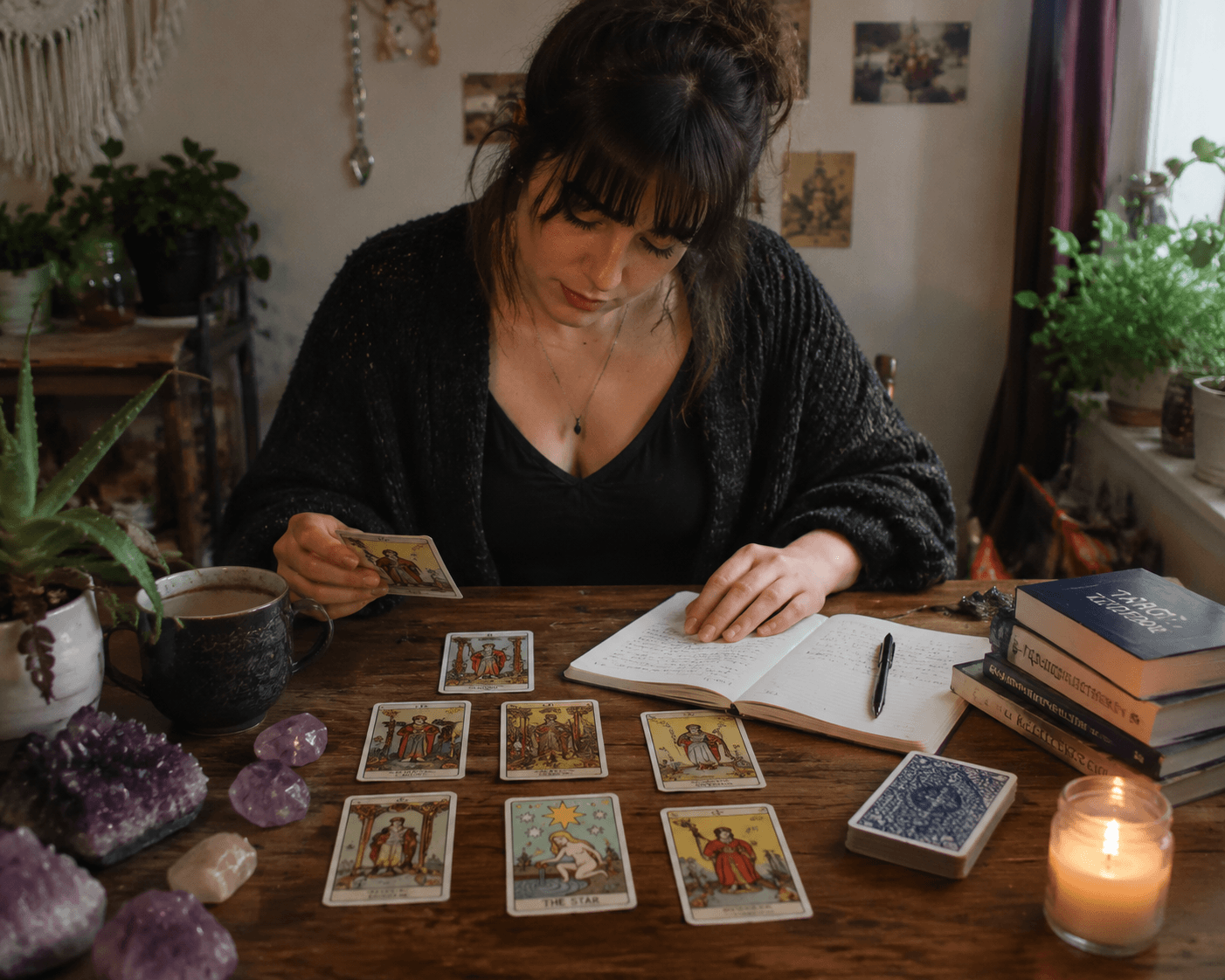
Step 1: Create a Clear Question
Good questions are:
- Specific
- Focused
- Related to personal reflection
Examples:
✅ What should I focus on today?
✅ What can I learn from this situation?
✅ What perspective should I consider?
Step 2: Choose a Simple Spread
Beginners should start with:
One Card Spread
The easiest method.
Question:
“What should I know today?”
Three Card Spread
A popular beginner layout.
Examples:
Past – Present – Future
or
Situation – Challenge – Advice
Step 3: Draw Your Cards
Shuffle your deck while focusing on your question.
Choose cards using your preferred method.
There is no single required technique.
Step 4: Interpret the Cards
Consider:
- Traditional meanings
- Symbols
- Your intuition
- The question context
Do not worry about being perfect.
Learning comes through practice.
Common Beginner Tarot Mistakes
Many new readers experience similar challenges.
Trying to Memorize All 78 Cards Immediately
This can create frustration.
Instead:
- Learn gradually
- Practice regularly
- Review your notes
Depending Only on Guidebooks
Guidebooks are helpful, but tarot is also about interpretation.
Pay attention to:
- Images
- Feelings
- Personal observations
Buying Too Many Decks Before Learning
Many beginners collect decks but do not practice.
It is better to:
- Choose one deck
- Learn its symbols
- Build confidence
Expecting Perfect Readings Immediately
Like any skill, tarot improves with time.
Your first readings may feel uncertain.
Practice helps develop:
- Understanding
- Confidence
- Interpretation skills
Tarot Cards for Beginners: A Complete Guide to Starting Your Tarot Journey – Part 3
Best Beginner Tarot Spreads to Practice
After learning basic card meanings, the next step is practicing simple tarot spreads.
A tarot spread is the arrangement of cards used during a reading.
Beginners should start with smaller spreads because they are easier to understand.
1. One Card Tarot Spread
The one-card spread is the simplest tarot method.
It is perfect for daily practice.
How it works:
- Think about a question
- Shuffle your deck
- Draw one card
- Reflect on its meaning
Examples:
- What should I focus on today?
- What energy surrounds me?
- What lesson can I learn?
Benefits:
✅ Easy for beginners
✅ Helps learn card meanings
✅ Builds confidence
2. Three Card Tarot Spread
The three-card spread is one of the most popular layouts.
It provides more information while staying beginner-friendly.
Past – Present – Future
Card 1: Past
Represents previous influences or experiences.
Card 2: Present
Shows current energy or situation.
Card 3: Future
Explores possible directions.
Situation – Challenge – Advice
Another useful three-card layout:
Card 1:
What is happening?
Card 2:
What challenge should I understand?
Card 3:
What advice can I consider?
3. Love Tarot Spread for Beginners
Relationships are one of the most common reasons people explore tarot.
A simple love spread:
Card 1: Your Feelings
What emotions are you bringing into the relationship?
Card 2: Relationship Energy
What is the current connection like?
Card 3: Advice
What perspective should you consider?
4. Career Tarot Spread
Tarot can also be used for career reflection.
Simple layout:
Card 1: Current Situation
Where are you now?
Card 2: Strengths
What abilities can help you?
Card 3: Next Step
What direction can you explore?
5. Self-Discovery Tarot Spread
This spread focuses on personal growth.
Layout:
Card 1:
What should I understand about myself?
Card 2:
What pattern should I notice?
Card 3:
What area can I improve?
How to Practice Tarot Every Day
Consistency is one of the best ways to improve.
You do not need hours of practice.
Even 5–10 minutes can help.
Morning Tarot Practice
A simple routine:
Step 1
Draw one card.
Step 2
Write:
- Card name
- Keywords
- First impression
Step 3
Ask:
“How might this message relate to my day?”
Step 4
Reflect in the evening.
Ask:
- Did I notice this energy?
- What did I learn?
Keep a Tarot Journal
A tarot journal helps you track your progress.
Include:
Card Information
- Card name
- Meanings
- Symbols
Reading Notes
- Question
- Spread
- Cards drawn
- Interpretation
Personal Reflections
Write:
- Feelings
- Observations
- Lessons
How to Improve Your Tarot Intuition
Many beginners wonder how readers develop confidence.
Intuition grows through practice and observation.
Study the Images
Look carefully at:
- Colors
- Characters
- Objects
- Symbols
Ask:
“What stands out to me first?”
Trust Your First Impression
Before checking a guidebook, write your thoughts.
Your first reaction can help develop personal interpretation.
Connect Cards With Real Life
Notice how cards relate to:
- Experiences
- Emotions
- Decisions
- Situations
This creates deeper understanding.
Learn Card Combinations
As you gain experience, study how cards work together.
Examples:
The Lovers + Two of Cups
Themes:
- Connection
- Partnership
- Harmony
The Tower + The Star
Themes:
- Change
- Recovery
- New hope
The Sun + Ace of Pentacles
Themes:
- Success
- New opportunities
- Growth
Tips for Becoming Better at Tarot
Practice Regularly
Small daily practice is better than occasional long sessions.
Stay Curious
Keep learning:
- Card meanings
- Spreads
- Symbolism
- Different approaches
Avoid Comparing Yourself
Every reader develops differently.
Focus on your own learning process.
Keep Notes
Your journal becomes more valuable over time.
Final Thoughts
Learning tarot cards as a beginner is a journey of discovery.
You do not need to memorize all 78 cards immediately or become an expert overnight.
The best way to learn is:
- Understand the basic structure
- Study card meanings slowly
- Practice simple spreads
- Keep a tarot journal
- Reflect on your experiences
Tarot becomes easier when you build a personal connection with the cards.
Whether you are interested in tarot for self-reflection, creativity, or exploring new perspectives, starting with the basics creates a strong foundation.
Stay patient, keep practicing, and allow your understanding to grow naturally.
Frequently Asked Questions
How long does it take to learn tarot cards?
The learning process is different for everyone. Many beginners understand the basics within weeks, while deeper knowledge develops through continued practice.
What tarot deck is best for beginners?
Many beginners choose decks with clear imagery and traditional symbolism because they are easier to study.
Can anyone learn tarot?
Yes. Beginners can learn tarot by studying meanings and practicing regularly.
How many cards should beginners pull?
One-card and three-card spreads are usually the easiest starting points.
Do I need psychic abilities to read tarot?
No. Many people learn tarot through studying symbols, meanings, and personal interpretation.
How often should I practice tarot?
Daily or weekly practice can help build familiarity and confidence.
What is the hardest part of learning tarot?
Many beginners find remembering 78 card meanings challenging at first. A journal and regular practice can make learning easier.
Can I read tarot for myself?
Yes. Many people practice tarot for self-reflection and personal insight.