Tarot Card Meanings Cheat Sheet for Beginners: Complete Guide to All Cards
Introduction
Learning tarot can feel overwhelming at first.
With 78 different cards, each containing unique symbols, images, and interpretations, many beginners wonder where to start.
Questions like these are common:
- What does each tarot card mean?
- How do beginners remember card meanings?
- What are Major Arcana and Minor Arcana?
- Can you learn tarot without experience?
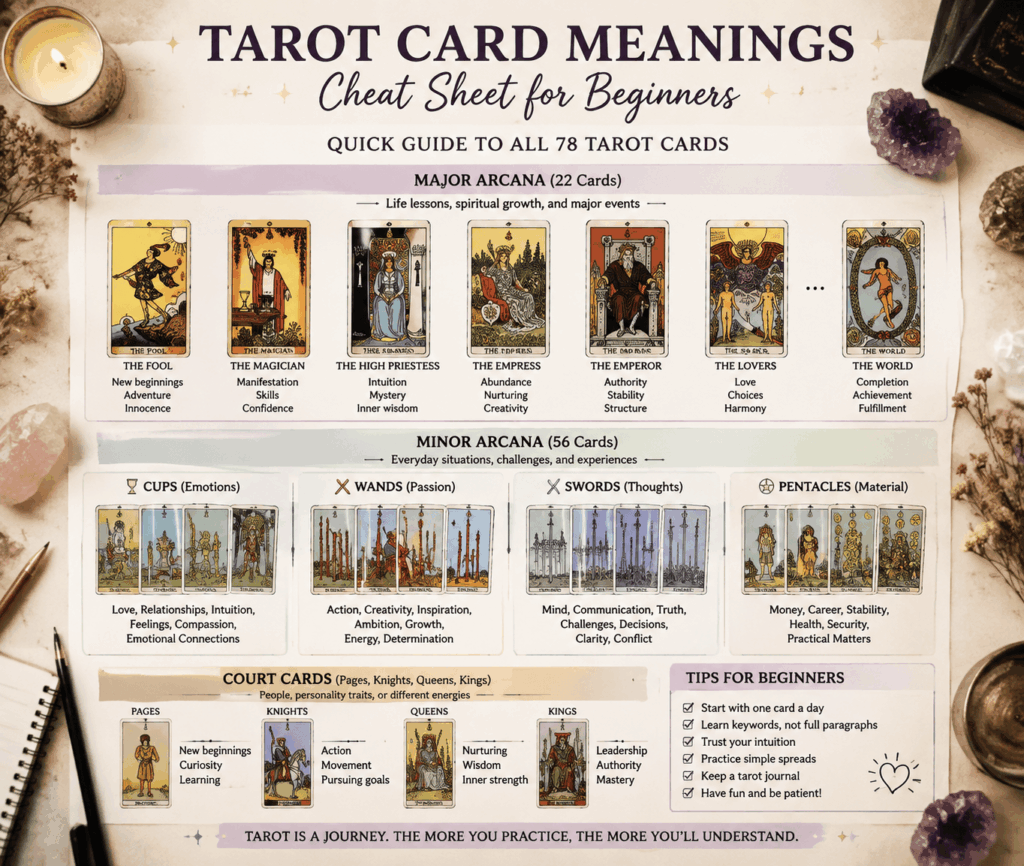
A tarot card meanings cheat sheet can make the learning process easier by providing a simple reference guide.
Instead of memorizing everything at once, beginners can slowly understand the themes, symbols, and messages behind each card.
In this guide, we will explore:
- How tarot cards are organized
- Major Arcana meanings
- Minor Arcana meanings
- Tips for remembering cards
- How beginners can start reading tarot
What Are Tarot Card Meanings?
Tarot card meanings are interpretations connected to the symbols, images, and themes found on each card.
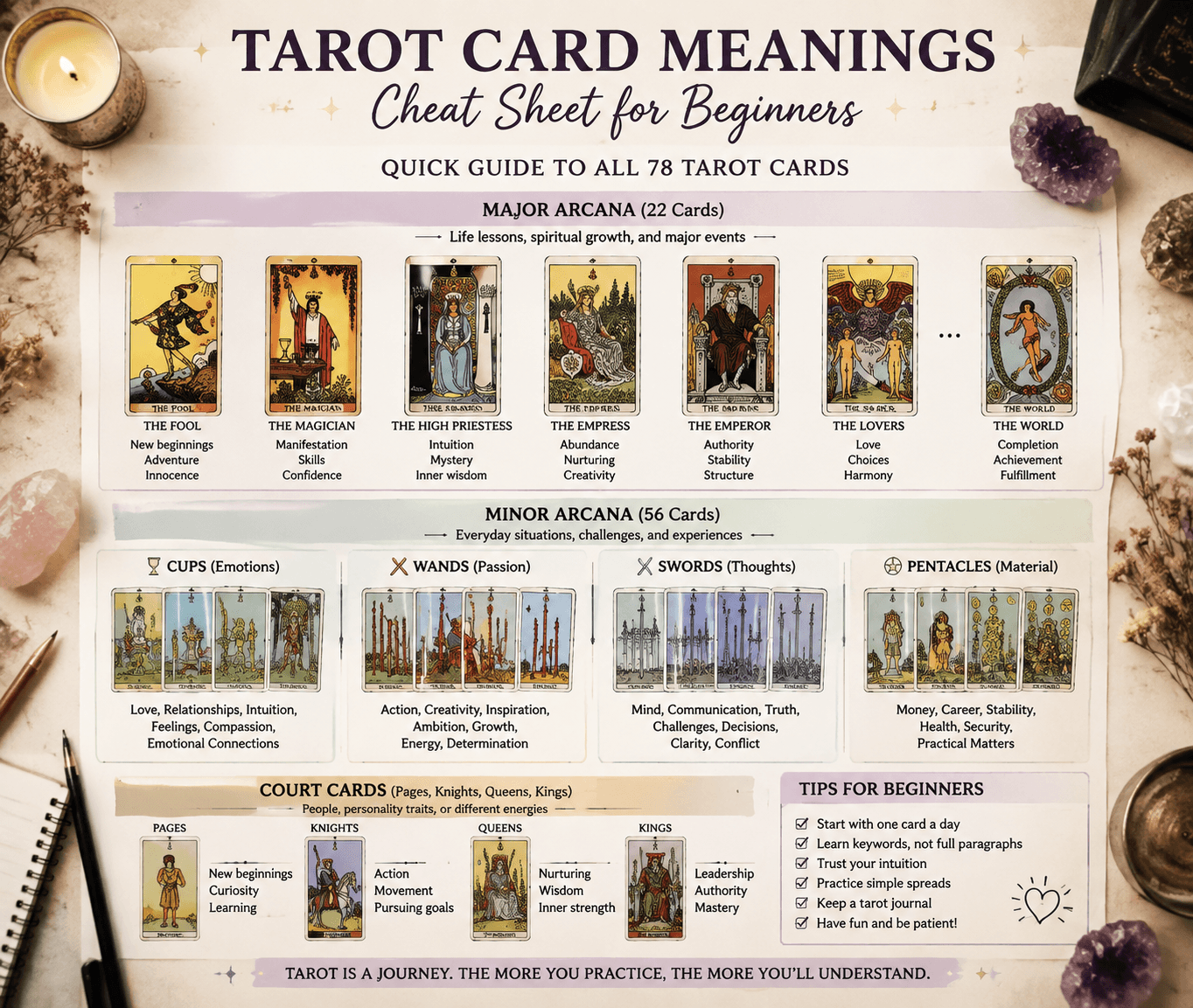
A tarot deck contains 78 cards divided into two main groups:
Major Arcana
The 22 Major Arcana cards represent major life themes, personal growth, and important experiences.
Examples:
- The Fool
- The Magician
- The Lovers
- The Tower
- The Star
- The World
Minor Arcana
The 56 Minor Arcana cards represent everyday experiences, emotions, challenges, and situations.
They are divided into four suits:
- Cups
- Wands
- Swords
- Pentacles
Each suit represents a different area of life.
Understanding Major Arcana Tarot Cards
The Major Arcana is often considered the foundation of tarot learning.
These cards represent important lessons and significant moments.
The Fool
Keywords:
New beginnings, adventure, taking a leap
The Fool represents starting a new journey with curiosity and openness.
The Magician
Keywords:
Manifestation, skills, confidence
The Magician reminds you that you have tools and abilities to create change.
The High Priestess
Keywords:
Intuition, mystery, inner wisdom
This card encourages listening to your inner voice.
The Empress
Keywords:
Creativity, abundance, nurturing
The Empress represents growth, comfort, and creative energy.
The Emperor
Keywords:
Structure, stability, leadership
The Emperor relates to organization and creating strong foundations.
The Lovers
Keywords:
Love, relationships, choices, harmony
The Lovers card is often connected with relationships and emotional connections.
It can represent:
- Romantic partnerships
- Important choices
- Personal values
- Creating harmony
This card reminds you that meaningful connections often require honesty and understanding.
The Chariot
Keywords:
Determination, direction, control, success
The Chariot represents moving forward with confidence.
It may suggest:
- Staying focused on your goals
- Overcoming challenges
- Taking control of your path
This card encourages confidence and persistence.
Strength
Keywords:
Inner power, patience, courage
Strength is not only about physical power.
It represents:
- Emotional control
- Compassion
- Confidence
- Inner resilience
This card reminds you that patience can be a powerful force.
The Hermit
Keywords:
Reflection, wisdom, solitude
The Hermit represents looking inward for answers.
It can relate to:
- Personal growth
- Self-discovery
- Taking time to reflect
This card encourages slowing down and listening to yourself.
Wheel of Fortune
Keywords:
Change, cycles, opportunities
The Wheel of Fortune represents movement and change.
It may indicate:
- New opportunities
- A turning point
- Changing circumstances
This card reminds us that life constantly moves through different phases.
Justice
Keywords:
Balance, truth, decisions
Justice represents fairness and honesty.
It can relate to:
- Important choices
- Taking responsibility
- Finding balance
This card encourages looking at situations clearly.
The Hanged Man
Keywords:
New perspective, surrender, patience
The Hanged Man suggests looking at things differently.
It may represent:
- Waiting before acting
- Seeing a situation from another angle
- Letting go of control
Death
Keywords:
Transformation, endings, new beginnings
The Death card is often misunderstood.
It usually does not represent a literal ending.
Instead, it symbolizes:
- Change
- Personal transformation
- Leaving the past behind
Temperance
Keywords:
Balance, healing, harmony
Temperance represents finding a middle ground.
It can suggest:
- Patience
- Emotional balance
- Creating harmony
The Devil
Keywords:
Attachment, temptation, limitations
The Devil card may represent situations where someone feels restricted.
It can relate to:
- Unhealthy habits
- Fear
- Strong attachments
This card encourages awareness and personal freedom.
The Tower
Keywords:
Sudden change, awakening, disruption
The Tower represents unexpected changes.
Although it can feel challenging, it may bring:
- Truth coming to light
- New understanding
- Breaking old patterns
The Star
Keywords:
Hope, inspiration, renewal
The Star is often considered a positive card.
It represents:
- Healing
- Optimism
- Faith
- New possibilities
The Moon
Keywords:
Intuition, uncertainty, hidden things
The Moon relates to emotions and things that are not immediately clear.
It may suggest:
- Trusting intuition
- Looking deeper
- Exploring hidden feelings
The Sun
Keywords:
Joy, success, positivity
The Sun represents happiness and clarity.
It may symbolize:
- Achievement
- Confidence
- Positive energy
Judgement
Keywords:
Reflection, awakening, decisions
Judgement represents reviewing experiences and moving forward.
It can relate to:
- Personal growth
- Important realizations
- New phases of life
The World
Keywords:
Completion, achievement, fulfillment
The World represents finishing a journey.
It may indicate:
- Accomplishment
- Success
- A completed cycle
How Beginners Can Remember Major Arcana Cards
Learning 22 cards may seem difficult at first, but beginners can use simple techniques.
Learn the Story Behind the Cards
Major Arcana can be viewed as a journey.
The Fool begins a journey and The World represents completion.
Understanding this story makes remembering meanings easier.
Focus on Keywords First
Do not try to memorize every interpretation.
Start with three keywords per card.
Example:
The Star:
- Hope
- Healing
- Inspiration
Practice One Card Daily
A simple beginner exercise:
- Choose one card
- Study the image
- Write your first impression
- Compare it with traditional meanings
Over time, your understanding will improve.
Minor Arcana Tarot Card Meanings for Beginners
The Minor Arcana contains 56 tarot cards and represents everyday experiences, emotions, decisions, and challenges.
Unlike the Major Arcana, which focuses on major life lessons, Minor Arcana cards often describe daily situations.
The Minor Arcana is divided into four suits:
- Cups
- Wands
- Swords
- Pentacles
Each suit represents a different area of life.
Cups Tarot Card Meanings
The Cups suit is connected with:
- Emotions
- Relationships
- Love
- Intuition
- Creativity
Cups are often associated with the element of water.
Ace of Cups
Keywords:
New emotions, love, intuition, emotional beginnings
The Ace of Cups represents a new emotional opportunity.
It may relate to:
- A new relationship
- Emotional healing
- Creative inspiration
Two of Cups
Keywords:
Connection, partnership, harmony
The Two of Cups represents emotional connections.
It may symbolize:
- Romantic relationships
- Friendship
- Mutual understanding
Three of Cups
Keywords:
Celebration, friendship, community
This card represents joy and connection with others.
It can relate to:
- Social gatherings
- Support systems
- Positive relationships
Four of Cups
Keywords:
Reflection, boredom, missed opportunities
The Four of Cups suggests looking inward.
It may indicate:
- Feeling disconnected
- Ignoring opportunities
- Needing a new perspective
Five of Cups
Keywords:
Loss, disappointment, healing
The Five of Cups represents emotional challenges.
It reminds us to focus not only on what was lost but also on what remains.
Six of Cups
Keywords:
Memories, nostalgia, kindness
The Six of Cups connects with:
- Past experiences
- Childhood memories
- Emotional comfort
Seven of Cups
Keywords:
Choices, imagination, possibilities
This card represents many options.
It may suggest:
- Exploring choices
- Avoiding confusion
- Looking for clarity
Eight of Cups
Keywords:
Moving on, change, searching
The Eight of Cups represents leaving something behind.
It can relate to:
- Personal growth
- New journeys
- Emotional changes
Nine of Cups
Keywords:
Satisfaction, wishes, happiness
Often called a card of emotional fulfillment.
It represents:
- Enjoyment
- Gratitude
- Personal satisfaction
Ten of Cups
Keywords:
Harmony, happiness, emotional fulfillment
The Ten of Cups represents:
- Strong relationships
- Family connection
- Emotional happiness
Wands Tarot Card Meanings
The Wands suit represents:
- Passion
- Energy
- Creativity
- Ambition
- Action
Wands are connected with the element of fire.
Ace of Wands
Keywords:
New ideas, inspiration, motivation
The Ace of Wands represents a spark of creativity.
It may indicate:
- New projects
- Fresh opportunities
- Excitement
Two of Wands
Keywords:
Planning, choices, future goals
The Two of Wands represents looking ahead.
It can relate to:
- Making plans
- Exploring possibilities
- Setting goals
Three of Wands
Keywords:
Expansion, progress, growth
This card suggests movement forward.
It may represent:
- New opportunities
- Growth
- Future success
Four of Wands
Keywords:
Celebration, stability, achievement
The Four of Wands represents joyful moments.
It can relate to:
- Celebrations
- Home life
- Milestones
Five of Wands
Keywords:
Competition, challenges, conflict
This card represents obstacles that require effort.
It may indicate:
- Competition
- Different opinions
- Growth through challenges
Six of Wands
Keywords:
Victory, recognition, confidence
The Six of Wands represents success and achievement.
It may symbolize:
- Recognition
- Progress
- Confidence
Seven of Wands
Keywords:
Protection, courage, determination
This card suggests standing your ground.
It represents:
- Defending your beliefs
- Staying strong
- Persistence
Tarot Card Meanings Cheat Sheet for Beginners – Part 4
Minor Arcana Tarot Card Meanings (Continued)
Wands Tarot Card Meanings (Continued)
Eight of Wands
Keywords:
Speed, movement, communication, progress
The Eight of Wands represents fast-moving energy.
It may indicate:
- Quick changes
- Important messages
- Progress after waiting
This card suggests that situations may begin moving forward.
Nine of Wands
Keywords:
Persistence, resilience, boundaries
The Nine of Wands represents staying strong despite challenges.
It can relate to:
- Protecting your progress
- Learning from past experiences
- Continuing forward
Ten of Wands
Keywords:
Responsibility, pressure, burden
The Ten of Wands represents carrying too much.
It may suggest:
- Taking on many responsibilities
- Feeling overwhelmed
- Needing better balance
Page of Wands
Keywords:
Curiosity, creativity, new ideas
The Page of Wands represents exploration and enthusiasm.
It may indicate:
- Learning something new
- Creative inspiration
- A new adventure
Knight of Wands
Keywords:
Passion, confidence, action
The Knight of Wands represents movement and ambition.
It can symbolize:
- Taking action
- Following your goals
- Excitement
Queen of Wands
Keywords:
Confidence, independence, creativity
The Queen of Wands represents personal power.
She symbolizes:
- Self-confidence
- Leadership
- Passion
King of Wands
Keywords:
Vision, leadership, achievement
The King of Wands represents strong direction and ambition.
It may relate to:
- Success
- Entrepreneurship
- Taking control
Swords Tarot Card Meanings
The Swords suit represents:
- Thoughts
- Communication
- Decisions
- Challenges
- Truth
Swords are associated with the element of air.
Ace of Swords
Keywords:
Clarity, truth, new ideas
The Ace of Swords represents mental breakthroughs.
It may indicate:
- New understanding
- Important decisions
- Clear communication
Two of Swords
Keywords:
Choices, uncertainty, balance
The Two of Swords represents difficult decisions.
It may suggest:
- Needing more information
- Avoiding a choice
- Finding balance
Three of Swords
Keywords:
Heartbreak, sadness, healing
The Three of Swords represents emotional pain.
It can relate to:
- Disappointment
- Separation
- Learning through experiences
Four of Swords
Keywords:
Rest, recovery, reflection
The Four of Swords suggests taking a pause.
It may represent:
- Rest
- Recovery
- Thinking before acting
Five of Swords
Keywords:
Conflict, tension, lessons
The Five of Swords represents disagreements.
It may indicate:
- Arguments
- Competition
- Understanding consequences
Six of Swords
Keywords:
Transition, moving forward, change
The Six of Swords represents leaving difficulties behind.
It can symbolize:
- A new chapter
- Emotional movement
- Progress
Seven of Swords
Keywords:
Strategy, independence, hidden actions
The Seven of Swords represents careful thinking.
It may suggest:
- Planning
- Being aware
- Looking deeper into situations
Eight of Swords
Keywords:
Restriction, fear, limiting beliefs
The Eight of Swords represents feeling stuck.
It may relate to:
- Self-doubt
- Fear
- Seeing new possibilities
Nine of Swords
Keywords:
Worry, anxiety, overthinking
The Nine of Swords represents mental pressure.
It may indicate:
- Stress
- Concerns
- Negative thoughts
Ten of Swords
Keywords:
Ending, transformation, new beginning
The Ten of Swords represents completing a difficult phase.
It may symbolize:
- Closing a chapter
- Learning from experiences
- Moving forward
Page of Swords
Keywords:
Curiosity, learning, communication
The Page of Swords represents seeking knowledge.
It may indicate:
- New information
- Questions
- Observation
Knight of Swords
Keywords:
Action, ambition, speed
The Knight of Swords represents quick decisions.
It can symbolize:
- Taking initiative
- Strong opinions
- Moving forward
Queen of Swords
Keywords:
Wisdom, honesty, independence
The Queen of Swords represents clear thinking.
She symbolizes:
- Truth
- Intelligence
- Strong boundaries
King of Swords
Keywords:
Logic, authority, decision-making
The King of Swords represents reason and leadership.
It may relate to:
- Fair decisions
- Knowledge
- Strategic thinking
Pentacles Tarot Card Meanings
The Pentacles suit is connected with:
- Money
- Career
- Work
- Security
- Health
- Material goals
Pentacles are often associated with the element of Earth.
This suit focuses on practical matters and everyday life.
Ace of Pentacles
Keywords:
New opportunities, abundance, stability
The Ace of Pentacles represents a new practical beginning.
It may relate to:
- A new job opportunity
- Financial growth
- A successful project
- Creating stability
Two of Pentacles
Keywords:
Balance, flexibility, priorities
The Two of Pentacles represents managing different responsibilities.
It may indicate:
- Balancing work and personal life
- Handling changes
- Adjusting to new situations
Three of Pentacles
Keywords:
Teamwork, learning, skill development
The Three of Pentacles represents cooperation and improvement.
It may symbolize:
- Working with others
- Building expertise
- Recognition for skills
Four of Pentacles
Keywords:
Security, control, saving
The Four of Pentacles relates to holding onto resources.
It may suggest:
- Financial planning
- Protecting what you have
- Being careful with decisions
Five of Pentacles
Keywords:
Challenges, hardship, support
The Five of Pentacles represents difficult periods.
It may relate to:
- Financial concerns
- Feeling unsupported
- Seeking help
Six of Pentacles
Keywords:
Giving, receiving, generosity
The Six of Pentacles represents balance between giving and receiving.
It may indicate:
- Support
- Kindness
- Fair exchanges
Seven of Pentacles
Keywords:
Patience, growth, evaluation
The Seven of Pentacles represents waiting for results.
It may suggest:
- Reviewing progress
- Long-term planning
- Continuing effort
Eight of Pentacles
Keywords:
Practice, dedication, improvement
The Eight of Pentacles represents developing skills.
It may relate to:
- Learning
- Hard work
- Mastering a craft
Nine of Pentacles
Keywords:
Independence, success, confidence
The Nine of Pentacles represents personal achievement.
It may symbolize:
- Financial independence
- Enjoying results
- Self-confidence
Ten of Pentacles
Keywords:
Legacy, family, long-term success
The Ten of Pentacles represents lasting stability.
It may relate to:
- Family connections
- Financial security
- Long-term achievements
Page of Pentacles
Keywords:
Learning, opportunity, curiosity
The Page of Pentacles represents a new practical journey.
It may indicate:
- Studying something new
- Career opportunities
- Personal development
Knight of Pentacles
Keywords:
Responsibility, patience, consistency
The Knight of Pentacles represents steady progress.
It symbolizes:
- Discipline
- Reliability
- Long-term effort
Queen of Pentacles
Keywords:
Nurturing, practicality, comfort
The Queen of Pentacles represents creating stability.
She may symbolize:
- Care
- Financial awareness
- A balanced lifestyle
King of Pentacles
Keywords:
Success, leadership, prosperity
The King of Pentacles represents achievement and security.
It may relate to:
- Business success
- Financial knowledge
- Leadership
Understanding Tarot Court Cards
Court cards can be confusing for beginners.
They include:
- Pages
- Knights
- Queens
- Kings
They can represent:
- Personality traits
- People
- Different approaches to situations
Page Cards
Pages represent:
- Learning
- Curiosity
- New beginnings
They often have youthful energy.
Knight Cards
Knights represent:
- Action
- Movement
- Pursuing goals
They show energy moving forward.
Queen Cards
Queens represent:
- Inner knowledge
- Understanding
- Emotional maturity
They often represent a deeper connection with the suit.
King Cards
Kings represent:
- Leadership
- Experience
- Control
They show mastery of the suit’s energy.
How Beginners Can Start Reading Tarot Cards
Learning tarot does not require memorizing every meaning immediately.
Beginners can start with simple steps.
Step 1: Learn the Basic Structure
Understand:
- Major Arcana
- Minor Arcana
- Four suits
- Court cards
This creates a strong foundation.
Step 2: Study One Card at a Time
Choose one card daily.
Write down:
- Card name
- First impression
- Traditional meaning
- Personal thoughts
Step 3: Practice Simple Questions
Beginners can start with reflection questions.
Examples:
- What should I focus on today?
- What lesson can I learn?
- What energy surrounds my current situation?
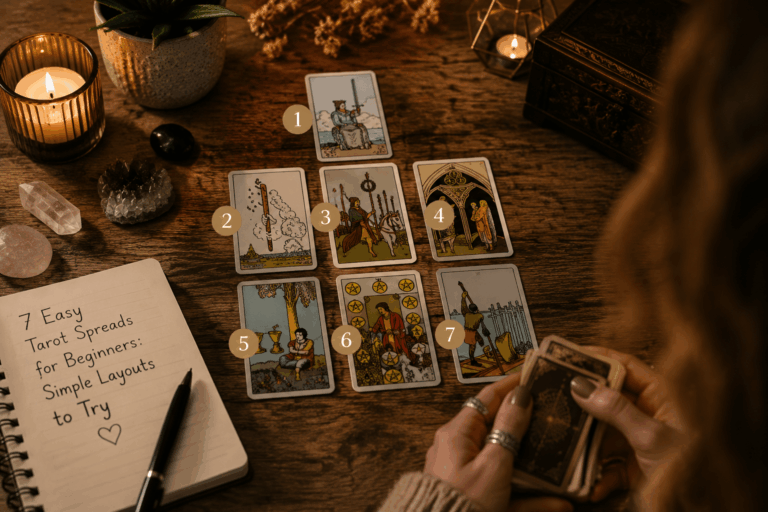
Step 4: Use Simple Tarot Spreads
Beginners do not need complicated layouts.
Simple spreads are easier to understand.
Examples:
One Card Spread
Question:
“What should I know today?”
Three Card Spread
Common format:
- Past
- Present
- Future
or:
- Situation
- Challenge
- Advice
Step 5: Combine Meaning With Intuition
Tarot learning is not only memorization.
Beginners can also consider:
- Images
- Colors
- Symbols
- Personal impressions
Best Beginner Tarot Spreads to Practice
After learning basic tarot card meanings, the next step is practicing simple tarot spreads.
A tarot spread is a specific arrangement of cards used to explore a question or situation.
Beginners should start with simple layouts before trying more advanced readings.
One Card Tarot Spread
The one-card spread is the easiest way to begin.
You simply draw one card and reflect on its meaning.
Common questions:
- What energy surrounds me today?
- What should I focus on?
- What lesson can I learn?
Benefits:
✅ Easy for beginners
✅ Helps build card familiarity
✅ Good for daily practice
Three Card Tarot Spread
The three-card spread is one of the most popular beginner layouts.
A common structure:
Past – Present – Future
Card 1:
Past influences
Card 2:
Current situation
Card 3:
Possible direction
Another option:
Situation – Challenge – Advice
Card 1:
What is happening?
Card 2:
What challenge should I understand?
Card 3:
What guidance can I consider?
Love Tarot Spread for Beginners
Love readings are one of the most searched tarot topics.
A simple relationship spread:
Card 1: Your Energy
What emotions or thoughts are you bringing into the situation?
Card 2: Relationship Energy
What is the current dynamic?
Card 3: Advice
What perspective may help?
Career Tarot Spread
For career questions, beginners can try:
Card 1: Current Situation
Where are you now?
Card 2: Strengths
What abilities can you use?
Card 3: Next Step
What direction can you explore?
Decision-Making Tarot Spread
When facing a choice:
Option A
Card 1:
Potential energy of this path
Option B
Card 2:
Potential energy of this path
Advice
Card 3:
What should you consider?
How to Create a Tarot Practice Routine
Consistency is one of the best ways to improve.
You do not need to spend hours every day.
A simple routine can help beginners develop confidence.
Daily Tarot Practice
A beginner routine:
Morning:
Draw one card.
Ask:
“What should I pay attention to today?”
During the Day:
Notice how the card relates to your thoughts or experiences.
Evening:
Write down:
- What happened?
- Did the card connect with your day?
- What did you learn?
Keep a Tarot Journal
A tarot journal is one of the most useful tools for beginners.
Record:
- Date
- Question
- Card drawn
- First impressions
- Traditional meanings
- Personal reflections
Over time, you will create your own understanding of the cards.
Common Beginner Tarot Mistakes
Learning tarot takes patience.
Many beginners make similar mistakes when starting.
Trying to Memorize Everything Immediately
With 78 cards, memorizing every detail can feel overwhelming.
A better approach:
- Learn keywords first
- Understand themes
- Practice regularly
Ignoring Your First Impression
Beginners often focus only on guidebooks.
However, images and personal interpretations are also part of tarot practice.
Ask yourself:
- What do I notice first?
- What feeling does this card create?
- What symbols stand out?
Asking Too Many Questions
Repeatedly asking the same question can create confusion.
Instead:
- Ask clear questions
- Reflect on the answer
- Give yourself time
Expecting Only Positive Cards
Every tarot card has different lessons.
Cards traditionally viewed as challenging can still provide useful reflection.
Examples:
The Tower:
Change and transformation
Death:
Endings and new beginnings
Five of Cups:
Healing and emotional awareness
Using Tarot Only for Future Predictions
Many beginners think tarot is only about predicting the future.
However, many people use tarot for:
- Self-reflection
- Understanding emotions
- Exploring possibilities
- Personal growth
How Long Does It Take to Learn Tarot?
The learning process is different for everyone.
Some beginners understand basic concepts within weeks, while others continue learning for years.
Progress depends on:
- Practice frequency
- Personal interest
- Study methods
The important part is consistency.
Final Thoughts
Learning tarot card meanings can feel challenging at first, but beginners do not need to master everything immediately.
A tarot deck is a journey of learning symbols, patterns, and interpretations.
The best way to improve is:
- Learn the basic card meanings
- Practice simple spreads
- Keep a tarot journal
- Explore your own interpretations
A tarot card meanings cheat sheet is a helpful starting point, but experience comes through regular practice.
Whether you are interested in tarot for personal reflection, spiritual exploration, or simply learning a new skill, understanding the cards step by step makes the process easier.
Start with the basics, stay curious, and allow your understanding to grow naturally.
Frequently Asked Questions
How many cards are in a tarot deck?
A traditional tarot deck contains 78 cards:
- 22 Major Arcana cards
- 56 Minor Arcana cards
What is the easiest tarot spread for beginners?
The one-card spread is usually the easiest because it allows beginners to focus on one meaning at a time.
How can I memorize tarot card meanings?
Start with keywords, study one card at a time, and practice regularly with a tarot journal.
What are Major Arcana cards?
Major Arcana cards represent major life themes, lessons, and important experiences.
What are Minor Arcana cards?
Minor Arcana cards represent everyday situations, emotions, thoughts, and practical matters.
Can beginners read tarot cards?
Yes. Beginners can learn tarot by studying card meanings and practicing simple spreads.
Do tarot cards have fixed meanings?
Traditional meanings exist, but many readers also consider intuition, symbols, and personal interpretation.
What tarot cards are best for beginners?
Many beginners start with simple decks such as Rider-Waite-style tarot because the images are easier to study.
How often should I practice tarot?
Even a few minutes daily can help improve familiarity and confidence.
Is tarot only about predicting the future?
No. Many people use tarot for reflection, self-awareness, and exploring different perspectives.